Bi-State Sustainable Reinvestment Corridor
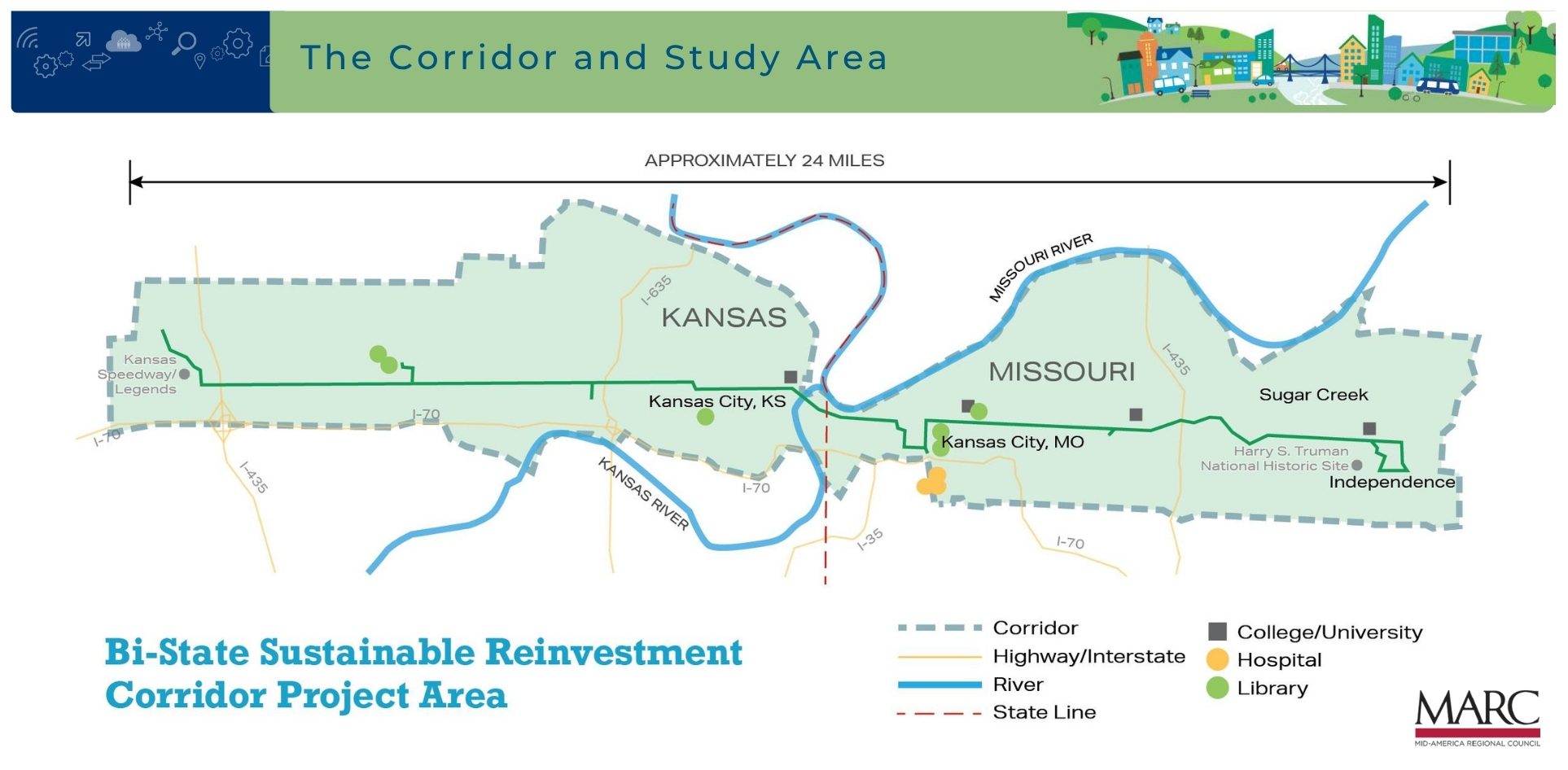
The Mid-America Regional Council (MARC) is coordinating a long-term multi-jurisdictional strategy to support infrastructure, transportation, and economic development along this 24-mile corridor connecting Independence, Sugar Creek, and Kansas City, Missouri, with Kansas City, Kansas. Meaning, multiple organizations and government entities are coming together to thoughtfully develop a specific area in several phases. The partners involved in the corridor project include civic and business organizations, along with the Unified Government of Wyandotte County and Kansas City, Kansas; City of Kansas City, Missouri; Jackson County, Missouri; City of Independence, Missouri; City of Sugar Creek, Missouri; Kansas City Area Transportation Authority; and MARC.
What is the Bi-State Sustainable Reinvestment Corridor?
Starting west at Village West in Kansas City, Kansas and heading east to Independence, Missouri is a 24-mile long corridor which crosses State Line. This area is made up of diverse communities of people and businesses with unique needs.
The corridor includes densely populated urban centers to metropolitan attractions, and small town historic communities to industrial areas. The corridor has tremendous potential to connect people to transportation, housing, health care, employment, and educational opportunities.
Project Goals
. Overall project goals are to:
- Updating existing transportation plans in multiple jurisdictions.
- Completing project development and environmental documentation for zero-emission transportation elements.
- Completing advanced conceptual engineering design for one or more high-capacity transit routes.
The comprehensive approach to corridor planning includes zero-emission transit, public infrastructure upgrades, energy-efficient housing, equitable Transit-Oriented Development (TOD), area-wide broadband, pedestrian and bicycle infrastructure, and workforce training associated with green stormwater infrastructure.
ADA or Title VI Issues?
RideKC is Here to Listen